
How to Search Civil Dockets
Pick the right court first. The 287th Judicial District Court handles general district civil, family, and child-protection cases. The constitutional County Court handles civil and probate work within its limits. Justice Court takes small claims, evictions, and debt claims. Files sit with different clerks too. The District Clerk holds district cases. The County Clerk holds county civil and probate records. Justice Court keeps its own.
Start at the county-linked LGS portal by choosing an office and record type. The official FAQ lists Civil, Probate, Property, and Criminal as separate options. Guest searching is free and may show index details plus previews. Full images can cost money or require a subscription. If your case is not online, call the District Clerk at 806-272-3165, the County Clerk at 806-272-3044, or the Justice Court at 806-272-4300.
- Choose district, county, probate, or justice jurisdiction.
- Select the matching office and record type.
- Search by cause number when it is known.
- Compare party names, dates, and case type.
- Ask the custodian for the needed document or certification.
Bailey Civil Courts Compared
Not every Bailey County civil case lands in the same courtroom. The 287th District Court hears general civil claims, along with separate family and child-protection dockets. The constitutional County Court has limited civil jurisdiction. That limit comes from state law. It also runs its own probate stream. Justice Court handles the lower-dollar work: small claims, evictions, and debt. A Muleshoe citation is a municipal matter. Paying it feels like a civil transaction, though it is not one.
| Matter | Likely court | Custodian |
|---|---|---|
| General district claim | 287th District Court | District Clerk |
| County civil or probate | Constitutional County Court | County Clerk |
| Small claim, eviction, debt claim | Justice Court | Justice Court |
Which court controls depends on the claim type and the amount involved. Give the clerk enough facts to route your request, but never ask staff for legal advice.
What a Civil Docket Shows
Think of a Bailey County civil docket as a timeline, not the full file. Portal fields can differ by office, so check the actual search screen rather than assuming a fixed layout. The register may list a filing while its image stays locked behind a fee or a restriction.
| Case number | The court's cause identifier and best exact-search key. |
|---|---|
| Parties | Plaintiff and defendant, or petitioner and respondent. |
| Filings | Petition, answer, service return, counterclaim, exhibits, or notices. |
| Motions and orders | Requests presented to the court and signed judicial action. |
| Settings | Hearing, docket call, mediation, trial, reset, or continuance dates. |
| Disposition | Nonsuit, dismissal, settlement order, default, or final judgment. |
A filed allegation proves nothing by itself. An entry marked order is no substitute for reading the signed order.
Bailey LGS Record Selector
The LGS record selector saves searchers from a common Bailey County mix-up. Civil and Probate point to court work. Property points to recorded land and deed instruments. Both may sit in the County Clerk's custody. A property index will not tell you what happened in a lawsuit, so pick the record type that fits your question. The LGS search landing page is the official county-linked entry point.
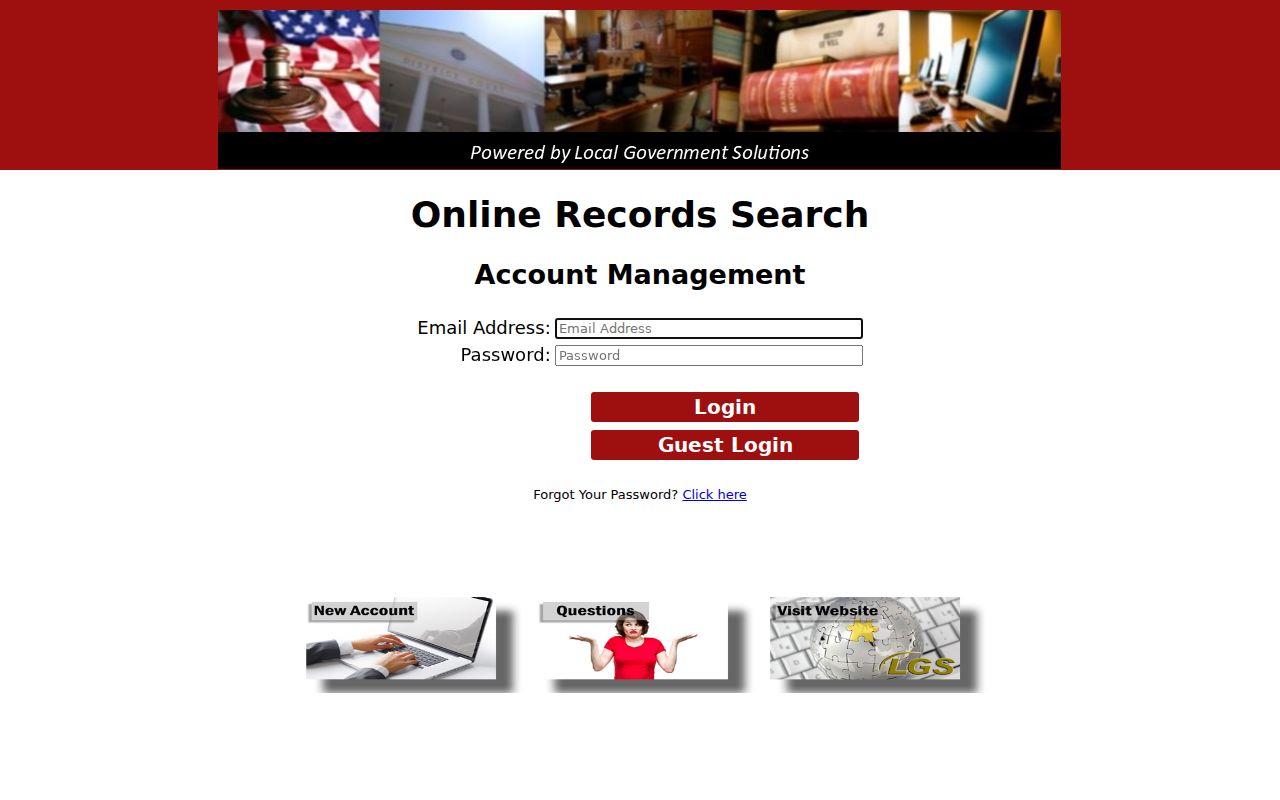
Live fields change by office and record type. Searching can be free while images cost money. LGS says a guest may preview information but cannot buy full images, and after five court-case image purchases a subscription kicks in. Every image purchase adds a mandatory 30-cent transaction fee.
Types of Civil Cases on the Docket
Civil covers several kinds of Bailey County proceedings, and venue still controls where the record lives. District activity reports split general civil from family work. County Clerk material separates civil from probate. Justice Court keeps the lower-dollar docket, and protected family, child, or medical details may be withheld or redacted even when the rest is public.
- Contract, debt, and other general civil claims.
- Property disputes filed as court cases.
- Family and child-protection matters where access is lawful.
- Probate cases in the County Court stream.
- Small claims, evictions, and debt claims in Justice Court.
A lawsuit over property is not the same thing as the deed index. Probate is a court record type, while marriage and vital records run through separate County Clerk systems.
Bailey Civil Activity in 2025
Texas Office of Court Administration numbers show the local scale. In fiscal 2025, Bailey's district civil category opened with 183 active pending cases, added 37, disposed of 82, placed three inactive, and closed with 135 active pending. The family category opened with 236, added 36, disposed of 40, and ended at 233 active pending.
Justice Court civil activity started at 276 active pending, added 73, disposed of 55, and finished at 293. Those are docket movement numbers. They do not count people, wins, or judgments.
Settings and Hearings on Civil Dockets
A notice of setting names a scheduled event. It usually lists a date, time, place, and setting type. A scheduling order can stack up several deadlines at once. Docket call may cover case status without being the trial. Mediation is a settlement process. Its outcome may show up later as an agreement, an order, or an unresolved status.
Resets and continuances push a hearing to a later date. They decide nothing. Confirm the current date with the clerk whenever the register lists more than one setting. Bailey County posts no complete daily civil calendar. The 287th District Court holds statutory Bailey terms beginning on the first Mondays in February and August. A term date is not your hearing date. The Bailey County court calendar explains how to confirm a setting.
Getting a Certified Bailey Judgment
Get the cause number first. Without it, ordering a certified Bailey County judgment goes nowhere fast. Once you have it, call or visit the District Clerk or the County Clerk. Confirm two things: which office holds the signed judgment, and whether you need a plain copy or a certified one. A printout from a browser screen is not certification. An abstract of judgment is its own clerk-made summary. It is not just another label for the judgment itself.
Government Code section 51.902 sets planning amounts for district clerks. It includes a $5 file search when no docket number is supplied. There is an $8 abstract of judgment. Certification charges shift with page count and format. The local fee schedule and the clerk's own practice control the real total. Ask for it up front. Confirm payment methods and delivery options at the same time. County Clerk fees can be checked against the fiscal 2026 schedule or verified by phone.
Public Access to Civil Dockets
Civil court records in Texas start out open to the public. That is the default under Texas Rule of Civil Procedure 76a. To seal a record, a party must show a serious and substantial interest. That interest must outweigh openness. The rule also asks whether a less restrictive option could protect that interest instead. None of this wipes out other confidentiality laws. Redaction duties still apply. Protective orders do too. Limits on juvenile and child-related material also stand on their own.
Key rules:
Texas Rule of Civil Procedure 76a supplies the civil-record openness and sealing standard.
Texas judiciary Rule 12 policy distinguishes court case records from non-adjudicative judicial records.
Texas Family Code chapter 58 protects juvenile records through special access and sealing provisions.
The Texas Public Information Act treats judicial records differently from ordinary executive-agency records. It simply does not govern court files the way it governs agency files. So a narrow case-record request goes straight to the clerk who keeps the file.
Bailey Orders Versus Entries
A Bailey County docket line saying an order was filed or signed is just an index event. It may not show the judge's full ruling. Findings, deadlines, and affected parties can all be missing. The same caution applies to a petition, a service return, a motion, and a settlement notice. It even covers a final judgment. Do not draw conclusions from a docket entry alone. Pull the image or ask the clerk for the filed document itself.
What if no image shows up online? Ask whether it is closed to guests, restricted, never digitized, or stored in a legacy format. Bailey's fiscal 2024 budget carried a microfilm-records line, so older record infrastructure still matters here, though the budget does not spell out which civil date ranges it covers. When you contact the clerk, give the cause number, the document title, the filing date, and the copy type you want. That narrow request helps the clerk find the right item without an extra file search.